What is an ETF?
An ETF (Exchange Traded Fund), is similar to a mutual fund in that its open ended, holds assets (predominately stocks or bonds) and aims to provide positive returns on investments. In Europe most ETFs are within the UCITS structure and regulated by the local regulatory body, such as the Central Bank of Ireland (CBI) or the Commission de Surveillance du Secteur Financier (CSSF). ETFs main difference to mutual funds, is that they trade on exchange like an equity, this provides advantages in terms of intra-day liquidity.
Most ETFs track an index, commonly known as a tracker. But recently active ETFs are becoming more popular and witnessing significant growth.
What are the key market trends?
When thinking about ETFs, there are two important themes which are central to this product, evolution and growth.
Ongoing evolution has been an important factor in the growth of ETF products. The first ETFs housed a single share class, just passive (equity) products Today’s ETF products have evolved far beyond passive into active and smart beta strategies*, holding virtually all asset classes, including multi-currency, multi-shareclass; hedged, unhedged, accumulating and distributing. Some recent discussions have centred around ETFs holding alternative and real assets or tokenised versions of these, which may be the next step in their evolution.
It took a long time for the European market to pick up on ETFs and by end 2010, assets had reached just $313bn. By 2019, ETF assets hit $1tn and since then have experienced double-digit compound annual growth. The latest figures for 2025 inflows show little sign of this growth slowing, with many market commentators bullish as to ETFs’ continued growth.
If you look at ETF growth on a longer term basis, ETFs assets are doubling every 5 years.
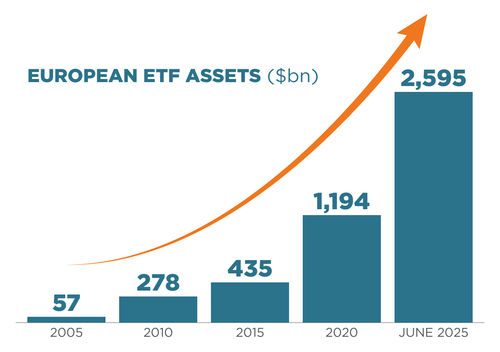
This pattern is leading key parties within the ETF industry to predict that this pace of growth will continue, JP Morgan forecasts that European ETF assets will reach $6tn by the end of 2030, while EY’s predict $4.5tn.
(*) Strategy aimed at outperforming market capitalisation-weighted indices by selecting and weighting securities according to specific criteria
Why launch an ETF?
There are a considerable number of tailwinds which are fuelling ETF growth such as, increasing use by retail investors, interest from younger investors and more interest in self directed investment. But it’s the core attributes of an ETF which are the key selling points, namely
▶ Accessibility – ETFs can be traded digitally making them highly accessible to all investor types
▶ Liquidity – ETFs can be traded on an intra-day basis, thus providing a high level of liquidity
▶ Transparency – ETFs publish fund holdings on a daily basis
▶ Low cost – ETFs are generally traded at a lower pricing point that mutual funds
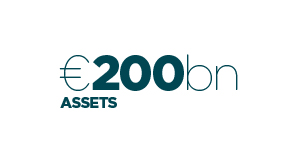
CACEIS ETF offering by the numbers

How we support your ETF business?
 |
EXPERT TEAM TO SUPPORT YOUR APs AND MMs
|
 |
ETF ORDER ENTRY PORTAL
|
 |
FUND ACCOUNTING
|
 |
PCF
|
Why choose CACEIS?
|
PARTNERSHIP Supporting clients throughout the entire launch process |
EXPERIENCE Top 5 provider of ETF-related services since 2016 |
EXPERTISE A dedicated team and centres of excellence serving ETFs |
|
INNOVATION Continuous evolution of our offering and tools |
ONE STOP SHOP A single provider covering the entire chain with a modular offering |
PRICING Competitive pricing offer |






Contacts
|
Paddy Walsh |
Eamonn O’Callaghan |


Insights